Saturday, February 19, 2011

RIOT; or does that just sell newspapers?


Fascinated, I’m watching northern Africa and the Middle East. People want rights. They want to be heard and the stories are visual, dramatic and touching. We hear the human voice and empathize with the pain.

I cry at senseless death too.

But what remains when the camera crews leave?

We all hope that they get democracy, jobs, equal rights and an education. In an ideal world…

I’m writing some, in Escape (Captive’s sequel) about these people’s protests. The situation there fascinates me. How to take the protest and turn it into good government and not a much worse dictatorships (known to happen after the military takes over). If these countries are lucky, strong leaders, who value the people, will arise and fill the power void. If not, the situations will only get worse.

Revolutions are so much written about in literature. You have the Russians, the French, the American, and so many others. Any time of great change brings out the imagination. A new order will come to replace the old. What will it look like?

Perhaps I should read more science fiction. I’ve read that in those books the most creative visions take hold to captivate a reader’s mind. My 2012 resolution? For now, reality is offering plenty a fertile ground for imagining a new reality. We started online and now it’s spreading beyond into people’s lives.

A few of the people who “like” Captive on Facebook live in Iran. I love that! No country is an island anymore…though many still don’t have connectivity and so can’t hook up to the world. Soon, soon.

As we’ve seen with the coming of this new year, change does come.

The pictures of the riots may sell newspapers: because boundaries continue to blur and the world gets smaller.

Sunday, February 13, 2011

Is Democracy the Best Religion


Is democracy the best religion: exportable and broadly workable in today’s diverse and divisive world? As practiced in the United States democracy is a representative form of government – with the majority deciding on their representatives. It is less the classic ancient Greek implementation – which went directly to the public for policy and decisions. Armed by the media, we are led to believe that democracy works for all countries. But where in modern history has democracy worked? In Haiti, Somalia, Iran and Zimbabwe? In such countries, democracy is synonymous with anarchy – run by an elected tyrant.

President Mubarak just chose to step down from his Egyptian post (nudged) and the military has taken over. They are reevaluating the country’s constitution. Events are too new for us to know whether the protestors’ cries were really accepted and a true democracy will be allowed to reign. Northern Africa and select middle-eastern countries have similarly been facing cries for freedom from long subjugated masses.
Not so long ago, Iran – nominally a democracy - had mass demonstrations – matched by bullets - against a (most likely) rigged election. Honduras ousted its elected president – Manuel Zelaya – who, taking lessons from Venezuela’s Hugo Chavez, was using elected power to change the country’s Constitution on his behalf (and was arrested based upon a warrant from the country’s Supreme Court). The American government supports Zelaya – though we don’t support his advisor, Chavez (also elected). We’ve long supported Mubarak and other like regimes in the region. With such examples, can we say that democracy has proven its workability outside of Western-oriented, economically developed countries?

Indeed, the list of recent successful (not nominal) democracies is small, and includes: Chile, Germany, India, Italy, Japan, Korea, Portugal, Spain and South Africa. What sets these countries apart from those that are democracies in name but not in practice? After all, in 1900 only 10 countries were democracies. That number reached 30 by mid-20th century then didn’t grow for 25 years. By 2005, 119 of the world’s 190 countries considered themselves democracies. So what defines a “true” democracy?

True democracy requires certain factors including: a strong rule of law; property rights; a broad based, effective educational system; a well developed middle class; separation of church and state; a system of checks and balances; fair elections; stable transitions to democracy; a multi-party system; freedoms of the press and speech; and incentives for the wealthy to create jobs and retain their capital domestically. Of these factors, a few typically precede the others. A strong rule of law and – somewhat related – property rights are non-negotiable foundations for true democracy.

Surprisingly, modern true democracies often follow disciplined dictatorships that established such basic rights. An enforceable code of laws creates certainty, fairness, recourse and a basis upon which to make long term planning assumptions. Property rights – and registration of property –protect the rich and support a functioning infrastructure: encouraging the wealthy to retain capital domestically and invest these assets in creating new jobs and industries. Collectively, these rights also provide the poor with stepping stones out of poverty by giving them an asset base to leverage and use as a foundation for building businesses. Capital is what powers a market economy – which then creates a solid middle class.

But establishing such a system can be rocky. In Chile the media still treats lauds Allende (democratic – elected by a minority) and demonizes Pinochet (dictator). Yet under Allende Chile had anarchy and a disrespect of law. The newly empowered masses showed no respect for contract or property rights and the economy spiraled downwards. Chile hadn’t built the necessary base to support a new democracy. Pinochet restored the rule of law, repaired the economy and brought back the middle class. His advisors included free market disciples such as Milton Friedman and the University of Chicago school of thought. True democracy followed; built on the framework Pinochet established using his dictatorial power.

Russia wasn’t prepared for democracy after communism and its rule of law was both weak and selectively enforced. It became a country of mobsters – with the former communist leaders being the mafia bosses. Putin – elected – was a dictator who restored order. Have the changes necessary to establish a true democracy been implimented? Thus far, the signs aren’t promising – in part because the rule of law is still being exercised as a political tool.

Zimbabwe took property rights away from the rich (white) farmers leading to starvation and ultimately chaos. The wealthy fled the country, taking their money and farming expertise. Foreign capital followed them. Today the country is in anarchy.

In contrast, in Peru Hernando De Soto Polar advised (elected) Presidents Fujimori and Garcia – to reform the property system which stabilized the economy and the currency. This upward mob of newly empowered (and better educated) used their newfound capital to increase production and expand the country’s collective wealth and prosperity. DeSoto has since gone on to advise numerous other “fledgling” democracies in helping create the strong middle class and accessible capital necessary for building a true democracy.

Can a true democracy flourish if hindered by religious, ethnic or other inconsistent ideologies? No democracy controlled by religious zealots has yet succeeded. Imams in a mosque aren’t competent rulers. Ultimately, they are taught to honor a holy book and not the realities of modern geopolitics. Dissenters face religious decrees and damnation.

Indeed, ethnic tensions, language differences and religious conflicts greatly complicate the implementation of democracy – the elected majority uses its power against the minority groups. Many countries have used the cover of democracy (or other forms of majority rule) to descend into anarchy, to limit the rights of minorities and to cover up – and perpetuate - war crimes. Yet, the United States – itself the greatest melting pot that ever existed – has shown that people will work together regardless of their differences – in a democracy.

Each political system has proven that the leaders and how they govern profoundly affects its eventual success. Yet no other system outside true democracy gives the people a strong voice and a real chance at long term prosperity. The Internet has “democratized” communication bringing a broad meeting of the masses – making democracy perhaps more relevant today than it has ever been. And, recent events have demonstrated, the people will speak up for their rights when elected leaders try to deprive them of true democracy. To quote Winston Churchill, “It has been said that democracy is the worst form of government except all the others that have been tried.”

Tuesday, February 1, 2011

Protests in Egypt: different from the Tahrir Square of my visit

Revolutions are all the same? People tire of repression and corruption leading them to risk everything for a better life?

I visited Cairo years ago and remember the guns, dirt and poverty. I put Khalil in a jail cell in the nearby desert in Captive. He gets the same bugs, heat and dirt that I had in one of my hotel rooms.

The repressive governments of Northern Africa and the Middle East are finally facing their people's anger. What do the people ask for? What we all ask for - the right to live a decent life. Where is the cry of Islam in this mayhem? So far it's been muted. Hopefully, militant extremists don't fill whatever power void these regions might face.

But isn't it great to watch the people uniting and speaking up for a better life?

Wednesday, January 26, 2011

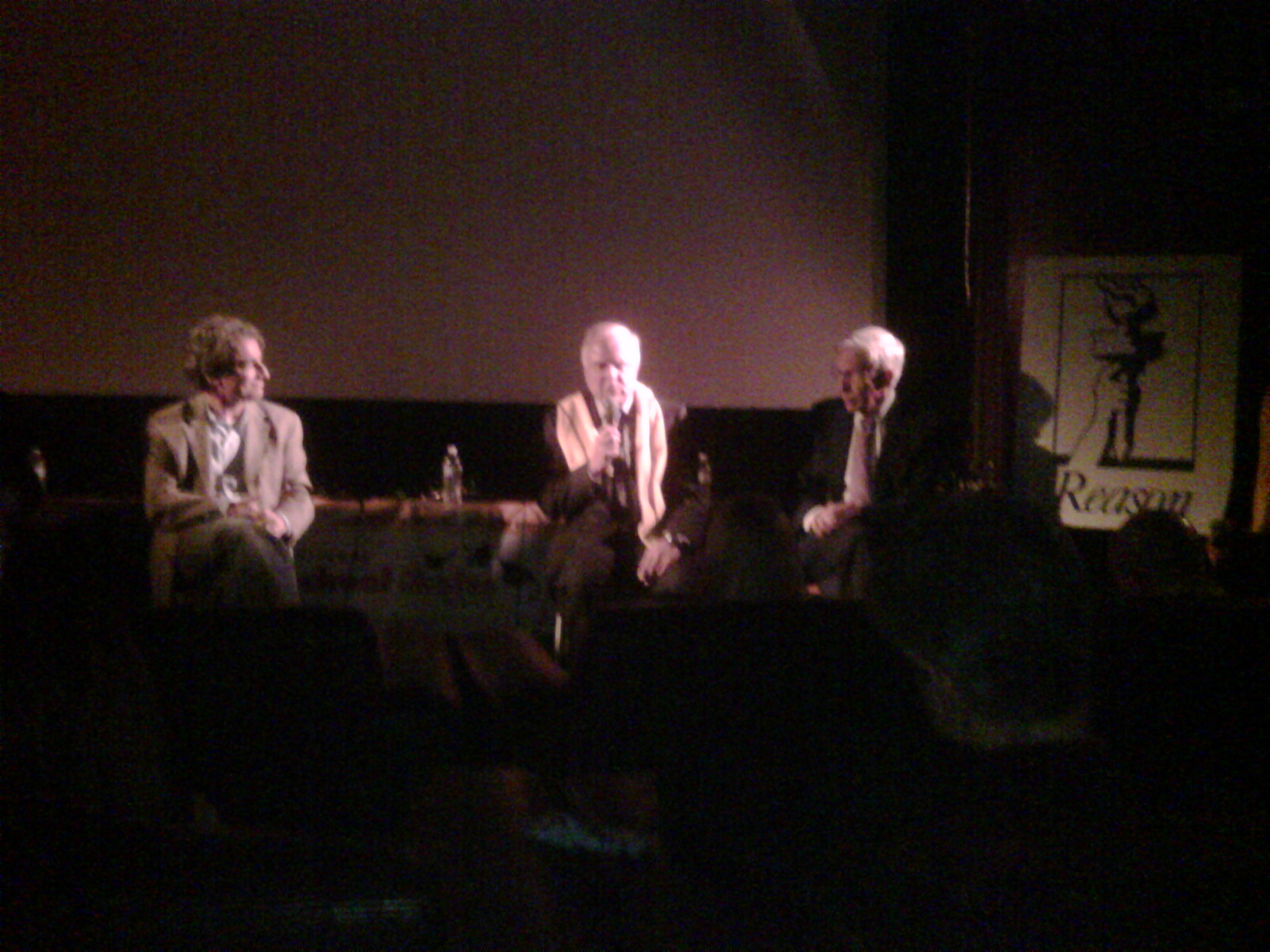
Reason Foundation's screening of The Lottery


Last night Reason Foundation had a screening of Madeleine Sackler's documentary The Lottery. The film follows a few families as their children apply to Harlem Success Academy, a charter school which can only accept a minority of its applicants.

Heartbreaking is watching the lottery results being read publicly. You see the small faces of those children of those not accepted fall as they realize that they failed to get in.

Worse is the comments from politicians and union representatives as they try to hinder the charter school's efforts to better educate poor children.

Eva Moskowitz, Harlem Success Academy's founder describes to a city counsel panel how the schools in Harlem were failing back when she was growing up and haven't gotten better in 35 years. The kids not testing at grade level ranges across schools but can be as low as 20%.

The panel that followed highlighted some exceptional people who are making an impact on educating in the United States. Reason's Lisa Snell moderated the panel. It included Richard Riordan, Frank Baxter, Ben Austin and Larry Sand.

I recommend the move to all and urge you to forward it on.

Thursday, January 20, 2011

Rep. Cohen, Nazi's, the GOP and Al Jazeera

Anderson Cooper “tears apart” Rep. Steve Cohen for comparing Republicans to Nazis? Shame on you, Anderson.

Rep. Cohen is using one of the most effective and widespread political techniques available to push his agenda - propaganda. And one can (hopefully safely) assume that the voters who elected him to office know that he is a democrat and will advocate for that position, using his discretion with how best to do so. Who determines what is true? And doesn’t truth sometimes depend on your ideology or perspective? We live in the age of attack politics and sound bites.

Goebbel’s tactic of repeating a lie over and over works. The technique is simple, effective and ubiquitous. Who is the “Great Satan”? Is Sarah Palin less able to govern because Katie Couric embarrassed her on national television or she spent too much on clothes? Did we all really need to hear over and over again Mel Gibson, likely drunk, threaten to beat up his estranged girlfriend? Does Al Jazeera need to show violent and gory pictures of war to support their oftentimes inflammatory and sometimes deliberately misleading viewpoint?

Sex, violence, addiction, scandals and abuse. Berlusconi and prostitutes. Weapons of mass destruction that are never found. Ann Coulter and the ACLU. Who knows what’s really true? In our end justifies the means political environment does it matter? If so many are repeating lies over and over again to persuade how can you call out one Representative and make him the villain?

Suddenly the media seems to be trying to change political rhetoric. A domestic assassination (Gifford) attempt will do that. Meanwhile, in Pakistan demonstrations are being held in support of Salmaan Taseer’s assassin. Taseer, remember, stood up to Islamists and lost his life for doing so. My message has been that religions don’t kill people; people do. How can you demonstrate in favor of an assassin? And the Pakistani lawyers group that fought government repression has even backed the assassin. Repeating the same lie over and over that Taseer was against the word of God. Who heard Allah speak?

And let’s not forget that Anderson Cooper has a vested interest as well. He has gotten a lot of press coverage for his attack. But has anyone questioned the validity of Rep Cohen’s point? Are the Republicans really like Goebbel’s in their methods? That sort of depends on your political beliefs doesn’t it? Why are we all angry, suddenly, that a politician in our country used inflammatory language? What if Cooper is just repeating the same lie?

“All art is propaganda,” asserted George Orwell. I’ve been open that Captive was written as a story and not a non-fiction book because doing so makes the issue of terrorism more accessible and understandable to a broader range of people.

Propaganda works. It works especially well if a short and simple message is repeated over and over again. The truth of that message sometimes depends on your ideology or who wins. Who determines what is true when those with a vested interest carefully craft their message and ruthlessly broadcast it to their constituents?

I’ll keep writing on this issue as the press coverage unfolds over the next few days. What did I miss in my assessment of the situation?

Wednesday, January 19, 2011

Captive “liked” by over 300 people on Facebook


Not everyone has read the book and not everyone will. But thank you for “liking” Captive!

The numbers keep growing…

When I first sat down to write a book I didn’t consider the marketing side of things. Had I done so I might not have written it! Writing is a private and very internal process. It can be lonely and is definitely introspective. It even ventures into obsessive and exacting as you work through the harder and less distinct parts of a story.

And much time is spent pondering how your characters get themselves in and out of trouble; this perfecting is key in all fiction but especially so with thrillers. Last weekend I made it a social affair when I met with a screen writer who has written a terrorist related script. We kept our voices down as we discussed how his characters should best create havoc. Not the type of thoughts you want to broadcast.

Yet when the book is done the writer is expected to become a promoter. Solitary no more!

When I first showed people my book I did it bashfully. Somehow I never realized until I held the actual book in my hands that people I knew might read it. Imagine being asked by your friends why you decided to write a few scenes that ventured on soft porn. Some people won’t and don’t like the book; a few will make you listen to why (note: I don’t really want to hear it unless it’s constructive).

All of this somehow I never thought through as I was writing. You write to create not to sell. And the book world has evolved along with other media sectors in that distribution and marketing isn’t working exactly as it did before. Book sales are falling; marketing is increasingly online (especially with my budget) and you are selling yourself along with the book.

Facebook, the blog, Twitter and trying to juggle it all.

The picture is from CalTech last weekend and I just like it.

Tuesday, January 11, 2011

Last night at the Milken Institute hearing Barry Eichengreen


I was at the Milken Insitute hearing Barry Eichengreen speak about his book Exorbitant Privilege (see www.ibla.us) and got side tracked on an unrelated conversation after the main event.

I wrote Captive because terrorism is an issue I take very seriously. And, while I don’t condemn or disagree with Islam I do disagree with how it’s being used today (religions don’t kill; people do). And so I had that conversation with someone raised Muslim but no longer practicing (thanks M!). Sidetrack one….

But I also discussed why I addressed terrorism in a novel. Sidetrack two… I referenced The Angel’s Game by Carlos Ruiz Zafon. The protagonist points out to the struggling writer – who he’s hired to create a new religion – that all major religions have a book that is a narrative, not a list of points or discussion. Why? Because people can connect with a story.

We want to see inside of someone’s thoughts and experience. Only then can we imagine their world and empathize. I can preach all I want but unless you agree with me in the beginning you likely won’t agree at the end. Did we always listen to our parents growing up?

So, I picked an issue and told a story about it. I brought in real people, a few bombs and hopefully some surprises. My ending is controversial but I don’t mind hearing that it’s wrong (Kitty). The fact that someone has an opinion means that the book reached them on an emotional level. Economists have a tougher time reaching their audience on an emotional level than do novelists. Or, perhaps, only good novelists can touch people on an emotional level?